Measured Biology
The Measured Biology of Morinda
Morinda citrifolia
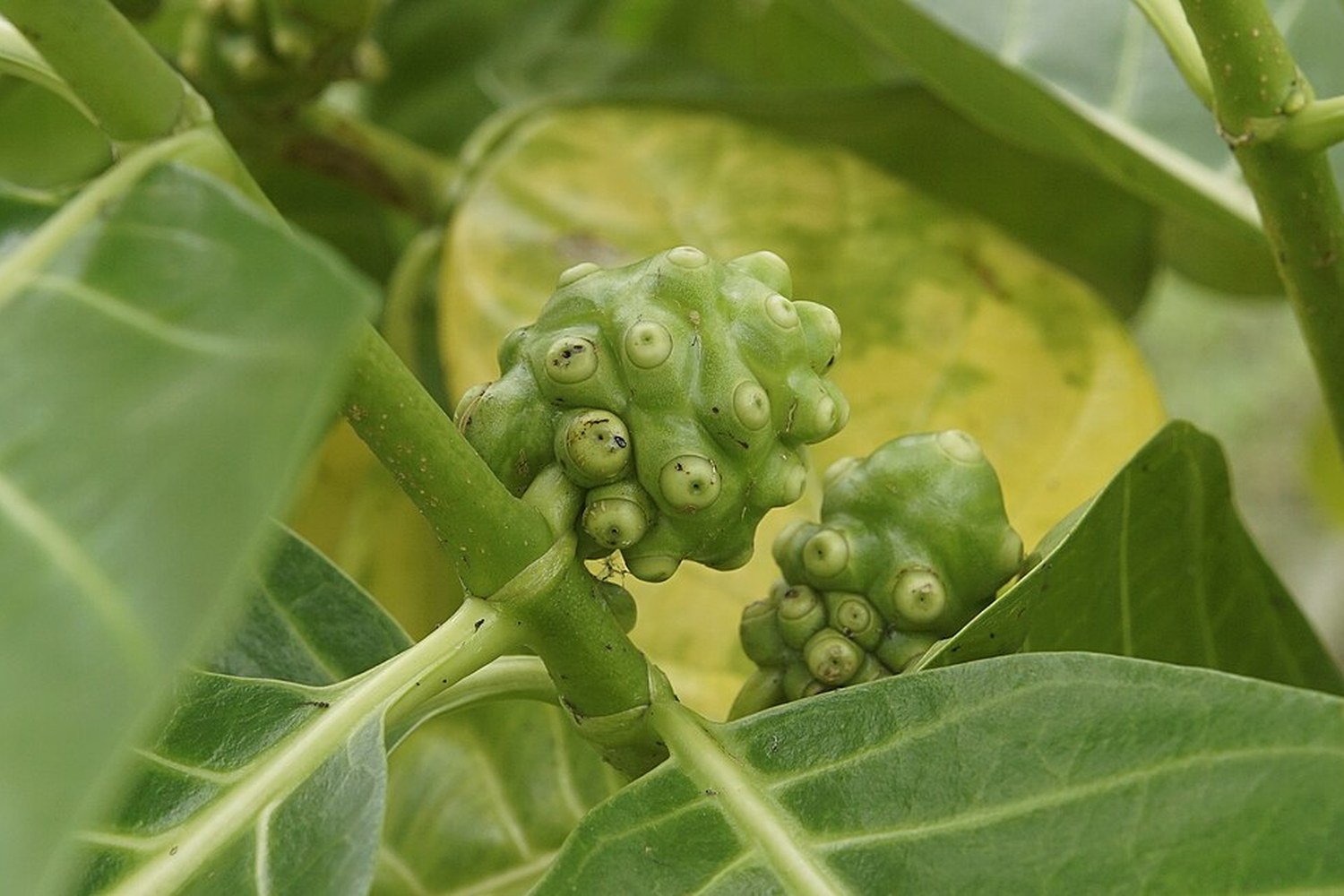
Morinda citrifolia — known across the Pacific as noni — is a small evergreen of the coffee family that thrives in the harshest coastal ground, taking root in lava flow and salt-sprayed sand where little else will hold. From this resilience the plant earns its standing as a foundational tonic: a botanical that, in our 10:1 extract, is concentrated for daily, sustained use rather than fleeting effect. Its sour, almost fermentive character marks it as a true tonic herb in the old sense — taken steadily, in small measure, to nourish the body's baseline of vitality rather than to push it. Native to Southeast Asia and carried by Polynesian voyagers across the open ocean to every island they settled, noni traveled in the same canoes as taro and breadfruit, prized as one of the canoe plants a people would not sail without. In the East Asian materia medica the same species appears as hai ba ji (海巴戟), placing it within a lineage that reaches from the Pacific to classical East Asian practice. It stands in the GGG catalog as a vitality root: a grounded, resilient plant whose own constitution — built to endure salt, sun, and stone — is the character it lends to those who take it.
In the body
Morinda's primary affinity is with the immune system, which it engages as a tonic rather than a stimulant — nourishing the body's own immune intelligence and its capacity for steady, self-regulating resilience rather than driving any single response. The plant's most established constituents are its iridoids, a class of secondary metabolites (deacetylasperulosidic acid and asperuloside chief among them) that distinguish noni chemically and which the body's antioxidant systems readily engage, supporting normal oxidative balance at the cellular level. Alongside these sit characteristic polysaccharides — long-chain plant sugars of the kind the immune system recognizes and uses as nutritional signal and substrate, in the manner of the broader family of immune-supporting botanical polysaccharides. The fruit additionally carries vitamin C, potassium, and a spectrum of organic acids that give it its sour signature and contribute to its standing as a cellular and metabolic tonic. Taken together, these compound classes are why noni is best understood as food for the body's systems: iridoids and polysaccharides that nourish the immune system's natural function and the body's everyday antioxidant balance, supporting deep, daily vitality, stamina, and resilience rather than acting upon any condition. A note of botanical discipline carried in our sourcing: only the deseeded, fully-ripe fruit is used as a tonic — the ripe fruit purées and powders are free of the anthraquinones found in seed and leaf material — and the fruit is naturally rich in potassium, which is why it is approached thoughtfully where mineral balance is already a consideration.
The molecules, measured
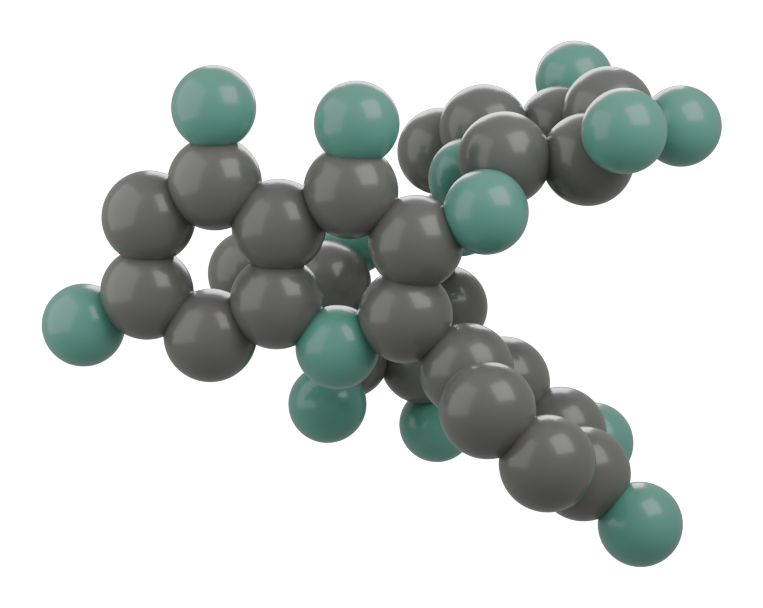
The active compounds in Morinda, the proteins each is measured to engage, and — where a real, exact-match assay exists — the strength of that binding.
Scopoletin
PubChem ↗Measured to act on
Carbonic anhydrase 9
An enzyme that helps cells balance acidity by managing carbon dioxide.
Quercetin
PubChem ↗Measured to act on
Amine oxidase [flavin-containing] A
An enzyme that breaks down messenger chemicals like serotonin in the nervous system.
Aromatase
The enzyme that converts androgens into estrogen, the body main estrogen source.
Aldo-keto reductase family 1 member B1
An enzyme that converts glucose into sorbitol as part of cellular sugar handling.
Cytochrome P450 1B1
A liver-type enzyme that processes hormones and environmental compounds.
Serine/threonine-protein kinase pim-1
A signaling enzyme involved in cell survival and growth.
ATP-binding cassette transporter ABCG2
A cellular pump that ushers compounds out of cells, shaping how the body absorbs them.
Damnacanthal
PubChem ↗Measured to act on
Tyrosine-protein kinase Lck
A signaling enzyme that helps immune T-cells activate and respond.
LIM domain kinase 1
An enzyme that shapes the cell's internal skeleton, guiding movement and structure.
Ursolic acid
PubChem ↗Measured to act on
Nuclear receptor ROR-gamma
A receptor that switches certain genes on, helping guide immune-cell development.
Sentrin-specific protease 1
An enzyme that removes regulatory tags from proteins to fine-tune their activity.
Transcription factor p65
A master switch that turns on genes coordinating the body's immune and inflammatory response.
Liver carboxylesterase 1
A liver enzyme that helps break down and process many compounds the body takes in.
The classical record
What tradition carried
Noni belongs to one of the oldest documented streams of Pacific plant practice. As a Polynesian canoe plant, it was deliberately propagated across Hawai'i, Tahiti, Samoa, and the wider Pacific, where it was relied upon as an everyday tonic fruit and a steady staple of island botanical life — its use recorded in the ethnobotanical literature of the region as a general restorative taken across generations. The same species enters the East Asian materia medica as hai ba ji (海巴戟), a tonic root within a tradition that values plants taken slowly and consistently to support the body's deep reserves. In the GGG lineage it is carried as a vitality tonic in this older sense: a plant whose authority rests on thousands of years of continuous human use across the Pacific and East Asia rather than on any single modern claim.