Reference
The body, system by system.
Herbs do not treat diseases — they nourish the body's own systems back toward balance. This is a working reference to those systems: what each one does, how the herbal tradition tends it, and the herbs and formulas we carry for it.
The body, by system
Every system, fed.
Nine systems carry you. Move through them — each one names the blends and formulas built to feed it.
System
Cardiovascular
The tireless circuit that feeds and clears every cell — heart and vessel, never resting.
Blends that feed it
Formulas

The Immune Terrain
The body keeps a standing watch — and the work of an herbalist is to keep that watch well-supplied.
The immune system is the body's distributed defense and surveillance network. It is not a single organ but a coordinated whole: barrier tissues like the skin and the lining of the gut and airways that decide what gets in; white blood cells that patrol the blood and lymph; lymph nodes, spleen, thymus, and bone marrow where those cells are made, matured, and staged; and a chemical signaling web that lets one cell call others to a site. It works in two layers that cooperate. The innate layer responds quickly and broadly to anything that reads as foreign or damaged. The adaptive layer responds more slowly but learns, building a specific, lasting memory of what it has encountered before. Day to day, much of its labor is quiet housekeeping — clearing worn-out cells and routine debris, keeping the body's own tissues recognized as self. A healthy immune system is therefore not a system that runs hot, but one that is balanced: responsive when it must be, and calm and discriminating the rest of the time.
The herbal tradition has long worked with this system not by aiming at any single threat, but by tending the terrain in which immune cells live and do their work. Across cultures the same instinct recurs: support the body's baseline resilience, steady its responses, and help it tolerate the ordinary stresses — seasonal shifts, exertion, fatigue, depleted reserves — that wear on it over time. This is structure-and-function work in the plainest sense. We are not asking a plant to do the immune system's job. We are nourishing the constitution so the system can do its own.
A defining contribution here is the tonic, adaptogenic, and host-supporting herbs and the medicinal fungi. Astragalus is among the most enduring tonics for the body's deep reserves, traditionally used to support underlying vitality and standing resilience rather than to provoke a response. Tulsi (Holy Basil), valued in the Ayurvedic lineage as an adaptogen, is taken to help the body steady itself under stress — and because chronic stress and depleted reserves are where immune balance frays, that steadying is itself supportive work. The fungi we carry — Reishi, Chaga, Turkey Tail, Agaricus Blazei, and the cordyceps-adjacent tonics — belong to a long tradition of host-supporting mushrooms valued for toning the body's surveillance and keeping its defensive housekeeping in good order. Reishi in particular is classically a calming, balancing tonic, fitting for a system whose health depends as much on restraint as on response. Clove and Morinda round out this terrain as warming, traditionally cleansing botanicals used to support a clean internal environment in which immune tissues thrive.
Our formulas gather these into coherent support. Immunity is built directly around this terrain — the tonic and fungal allies brought together to nourish the body's own defensive reserve and standing resilience. Balance speaks to the discriminating, calm side of immune health, supporting the steadiness on which a well-regulated system depends. Kidney supports the clearing and housekeeping work — the routine sweeping of debris that keeps the terrain sound. And Stamina recognizes that hard exertion taxes the body's reserves, supporting recovery and resilience in those who train. The through-line in all of it is the same: feed the constitution, steady the response, and let the body keep its own watch.
The herbs gathered here come from one human inheritance, not one people: the Western and Greek-Galenic apothecary, the Ayurvedic tradition of India, African herbcraft, and the East Asian and TCM materia medica all arrived independently at the same idea — that you support immune resilience by tending the body's reserves and balance, not by attacking. We carry that shared practice forward as common ground, for everyone.
Herbs we carry for it

The Inner Hearth
This is where food becomes you — or passes through.
The digestive system is the long, muscular passage that turns food into the body. It begins in the mouth and runs through the esophagus, stomach, small intestine, and large intestine, with the liver, gallbladder, and pancreas contributing enzymes and bile along the way. Its work is mechanical and chemical at once: it breaks food into molecules small enough to cross the gut wall, absorbs water and nutrients into the blood, hosts the vast community of microbes that line the intestine, and moves the residue onward for elimination. A steady rhythm of muscular contraction carries everything in one direction, while a dense lining and a layer of immune tissue decide, moment by moment, what enters the body and what passes through. When this system works well, you are nourished without noticing it; the entire body downstream depends on the quiet competence of the gut.
The herbal tradition has always treated digestion as the foundation of vitality, on the reasoning that no remedy reaches the body until the gut delivers it. Its approach is to support the system's own functions rather than to force them: to warm and rouse a sluggish stomach, to ease the muscular passage of a meal, to settle the lining when it is irritated, and to encourage the steady flow of bile and the regular work of elimination. The carminative and warming herbs sit at the center of this. Ginger is the clearest example we carry — a pungent, warming root used across traditions to rouse the appetite, encourage the stomach's movement, and settle a queasy or unsettled feeling after eating. Cinnamon plays a kindred role, a warm aromatic bark long used to comfort the digestive tract and lend its warmth to a meal that sits heavily.
A second pattern in the tradition is toning the organs that make digestion possible. Dandelion, root and leaf, is a classic bitter: bitterness on the tongue is itself a signal that prompts the body's own digestive secretions, and dandelion is used to support the liver and the steady flow of bile that helps the body handle a rich meal. Licorice is a sweet, soothing root traditionally used to calm and coat an irritated digestive lining and to harmonize a blend so the whole sits gently. Jujube, the sweet red date of East Asian practice, is a gentle, nourishing fruit used to tone a tired digestion and build the body back up, and it is often paired with the qi-supporting roots — Codonopsis, a mild, food-like root used to strengthen a weak digestion and restore appetite, and Dendrobium, valued for moistening and supporting the body when the lining feels dry and depleted. These are not stimulants but builders: they are meant to be taken steadily, to tone the system rather than push it.
Alongside nourishing and toning, the tradition keeps a place for gentle clearing — supporting the body's own work of binding and moving residue onward. Activated Charcoal and Bentonite Clay are traditional binding materials, porous and adsorptive, used to support the gut's own handling of unwanted matter and to settle an occasionally unsettled digestion. Our formulas gather these strands for the person who wants a considered, ready approach: Green leans on the warming, appetite-rousing herbs to support a steady digestive fire; Balance is built to tone and harmonize the system over the long term, the gentle builders working together; and Kidney draws on the binding and bitter herbs to support the body's natural rhythm of clearing and elimination. Each is offered as nourishment and support for the system's own functions, to be taken as part of an ordinary, well-tended life.
The herbs that support digestion belong to no single people: the warming and carminative roots, the bitters that wake the appetite, and the sweet building tonics appear together across Western and Greek-Galenic practice, Ayurvedic medicine, African herbal traditions, and East Asian and TCM lineages. We treat these as one human inheritance in the care of the gut — a shared craft of nourishing the body's own digestion, offered to everyone.
Herbs we carry for it

The Nervous Terrain
Every signal the body sends runs through here — and it steadies best when it's nourished, not pushed.
The nervous system is the body's communication network. The brain and spinal cord form its central core; a branching web of nerves carries signals to and from every tissue. Some of this traffic is voluntary, the deliberate movement of a hand; far more of it runs beneath awareness, the autonomic regulation of heartbeat, breath, digestion, and the moment-to-moment balance between effort and recovery. Sensory nerves gather information from the world and the interior; motor nerves carry instruction outward; and across countless junctions, chemical messengers translate one signal into the next. This system governs not only thought and movement but the entire rhythm of arousal and rest — the capacity to focus when focus is called for, and to settle when the demand has passed.
The herbal tradition has long concerned itself with the tone of this system rather than any single function of it — the difference between a nervous network that is taut and overstretched and one that is supple, responsive, and capable of returning to rest. The class of plants gathered under the old name of nervines were understood to nourish and steady this terrain: to support the body's own composure under load, and to help the transition between a waking, attentive state and the deeper recovery the system depends on. Our approach is continuous with this lineage. We work with herbs that support the structure and function of the nerves and the brain, and that help the whole network find and hold its baseline.
Among the herbs we carry for this terrain, Jatamansi — also called Spikenard — and Albizia have a long place in the tradition of plants used to settle an overstretched system and support a steady, composed baseline. Polygala belongs to the lineage of herbs valued for supporting mental clarity and the connection between a settled mind and an alert one. Lion's Mane, a culinary and medicinal mushroom, is carried for its traditional association with the nourishment of the brain and the supportive maintenance of cognitive function over time. None of these is a quick lever; each is chosen for the way it supports the system's own work rather than overriding it.
Our formulas gather these herbs by the kind of support a person is reaching for. Focus is composed toward attention and its steady function. Repose is composed toward the settling, restorative side of the system — supporting the body's own capacity to downshift into rest. Lift is composed toward a buoyant, even baseline. Each is built to tone the nervous terrain rather than to push it, on the principle that a well-nourished system regulates itself better than a forced one. The aim throughout is structural: a network that is fed, balanced, and able to move freely between attention and ease.
The plants that steady the nerves were named and worked with independently across the Western herbal of Culpeper, the Greek-Galenic physicians, the Ayurvedic materia medica of India, the African herbal traditions, and the East Asian and TCM lineages — one human inheritance arrived at many times over. We treat it as a single shared practice, held in common and meant for everyone.
Herbs we carry for it

The Living River
Every cell in the body is fed by a current that never rests.
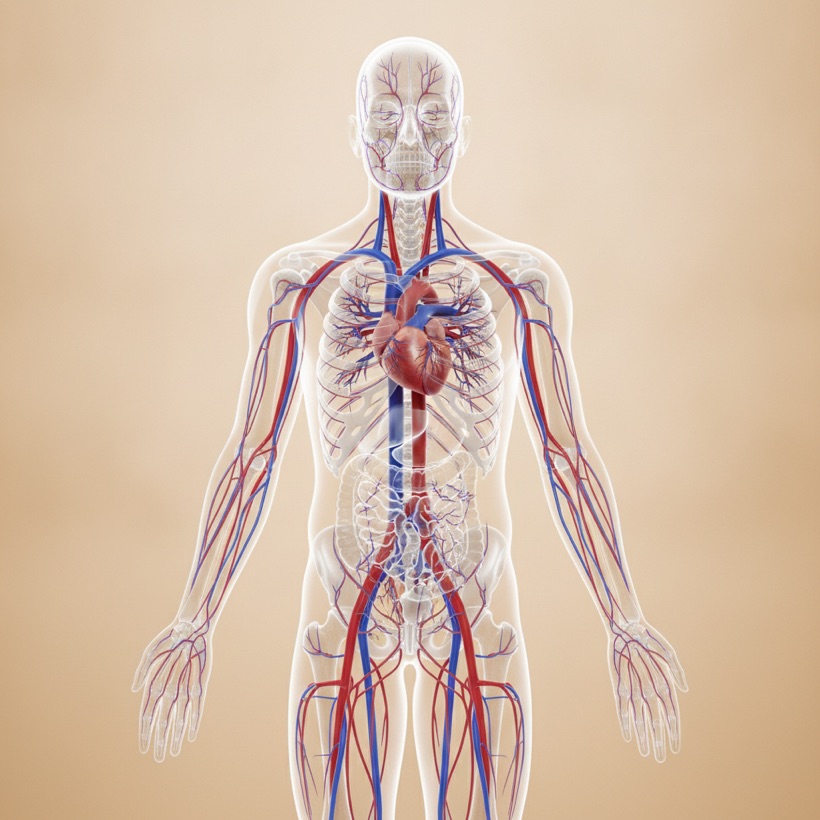
The circulatory system is the body's transport network: the heart, a muscular pump roughly the size of a fist, drives blood through a closed loop of arteries, veins, and the fine capillary beds where the real exchange happens. Blood carries oxygen out from the lungs, glucose and nutrients from the gut and liver, hormones from the glands, and immune cells everywhere they are needed; on the return journey it gathers carbon dioxide and metabolic waste for the lungs, kidneys, and liver to clear. Red cells handle the oxygen, white cells patrol for threats, platelets seal breaches in the vessel wall, and plasma carries the dissolved rest. It is one continuous river, and the quality of that river — how richly it is built, how cleanly it flows, how steadily the vessels hold their tone — shapes how well every other system is supplied.
The herbal tradition has always read the blood as something to be built and kept moving rather than merely managed. Across lineages the same two ideas recur: nourish the blood so it is rich and well-made, and keep the channels open so it travels freely to the tissues that depend on it. Our approach follows that grounded logic. Rather than chasing a single effect, we lean on herbs long used as blood-nourishing tonics and gentle movers — foods and roots the body can recognize and put to work — and we let physiology, not promise, set the boundary of what we claim.
Among the herbs we carry for this terrain, Rehmannia sits at the center of the blood-building tradition: a dense, sweet root used across East Asian and broader herbal practice as a foundational tonic where the work is to enrich and replenish. Jujube — the red date — holds a parallel reputation as a steady, food-like tonic taken to nourish and to soften the action of stronger herbs, the kind of plant kept in the kitchen as much as the apothecary. Mulberry and Purple Mulberry, leaf and fruit alike, belong to the same nourishing family, valued as gentle tonics that support the blood and the tissues it feeds. Burdock rounds out the picture from the cleansing side: a classic root of the Western and Greek-Galenic tradition, long taken to support the body's own channels of clearance, so that what the blood carries away can be carried away.
In our formulas this shows up as complements rather than competitors. Greens leans into the nourishing, chlorophyll-rich side of the work — building and feeding. Kidney supports the body's natural pathways of clearance, the downstream side of a healthy circulation, so the river runs clean as well as full. Balance is what its name describes: a tone-and-steady approach for a system whose whole virtue is even, uninterrupted flow. None of this treats a condition; it tends the terrain. The aim is a system kept well-supplied and well-drained, with vessels that hold their tone and blood that is richly made — the ordinary, durable foundation on which the rest of the body runs.
The work of building and moving the blood belongs to no single people — it appears, in its own vocabulary, in Culpeper's Western herbals and the Greek-Galenic physicians before him, in Ayurvedic rasayana tonics, in African root traditions, and in East Asian and TCM practice alike. We treat it as one human inheritance, carried in many tongues and offered back to everyone.

The Deep Reserve
The kidneys filter the body's inner sea, while the adrenals set the pace at which it is spent.
The kidneys are the body's principal filtration organs. Working continuously, they process the blood, draw off metabolic waste and excess water as urine, and conserve what the body still needs. In doing so they govern the volume and composition of the body's fluids, hold the balance of sodium, potassium, and other electrolytes within a narrow workable range, and help regulate blood pressure and the acid-base chemistry on which every cell depends. They also contribute to the renewal of red blood cells and to the activation of vitamin D for the skeleton. Seated just above them, the adrenal glands run the body's response to demand: they release the hormones — among them cortisol and adrenaline — that mobilize energy, sharpen attention, and help adjust fluid and salt balance through the day and across periods of stress. Kidney and adrenal work in concert, one managing the steady housekeeping of the inner sea and the other setting the tempo at which its reserves are drawn upon.
The herbal tradition has long treated this region of the body as the seat of deep reserve — the foundation of stamina, of recovery, of the capacity to meet demand without being depleted by it. The work of the herbalist here is not to drive the system but to nourish and tone it: to support the steady filtration the kidneys perform and to help the body keep its own response to stress within a sustainable rhythm. This is restorative work, measured in seasons rather than days, and it favors herbs of substance and depth over stimulation.
Several of the herbs we carry belong squarely to this tradition of replenishment. Rehmannia is among the most classical of the kidney-nourishing roots in East Asian herbal practice, prepared and valued as a tonic for the body's deep reserves and its underlying fluids. Cistanche is similarly esteemed as a substantial, grounding root used to support vitality and stamina at the foundation. Red Asparagus, a moistening tonic root, has long been used to nourish the body's fluids and lend resilience to a system worn by sustained output. These are not herbs of the quick lift; they are slow building blocks, chosen for the way they help the body restore what continuous work draws down.
Where the adrenal side of this system is concerned — the body's pacing of stress and demand — the tradition turns to the adaptogenic and harmonizing herbs. Eleuthero is a well-known supportive root used to help the body sustain steady energy and adapt to ongoing exertion, toning rather than spiking the stress response. Licorice, a harmonizing herb found across many lineages, is used to round and steady a formula and to support the body's own regulation of fluid and tone. In our own approach these herbs are composed rather than taken in isolation: formulas such as Balance are built to support the body's even, regulated state, while Kidney leans toward the filtering and clearing work that organ carries. The paired formulas Sun and Moon speak to the same rhythm from another angle — the body's daily alternation between active output and quiet restoration, the very cycle that the adrenal system governs and the kidneys quietly sustain.
The herbs gathered here come from one continuous human inheritance — the Western and Greek-Galenic materia medica, the Ayurvedic tradition, African herbal practice, and East Asian and TCM lineages — each of which independently recognized this deep-reserve system and built a vocabulary of roots to nourish it. We draw on all of them as a single craft, held in common and meant for everyone.

The Filtering Organ
The liver is the body's chemical refinery, and steady metabolic work is its measure of health.
The liver is the largest internal organ and the central processing station of the body's metabolism. Blood leaving the gut, carrying everything that has been absorbed from food and drink, passes through the liver first. There, the organ sorts what arrives: it converts nutrients into forms the body can store or use, builds proteins that circulate in the blood, manufactures bile that the body uses to break down dietary fat, helps regulate blood sugar by storing and releasing glucose, and transforms compounds the body needs to clear into water-soluble forms that can leave through the kidneys and bowel. It is a working organ in the most literal sense, performing many chemical conversions continuously, and it is also notable for its capacity to regenerate its own tissue. Because so much passes through it, the liver carries a heavy and continuous load.
The herbal tradition has long treated the liver as an organ to be supported rather than driven, and the plants associated with it are accordingly steady and unglamorous. The aim is to nourish the organ's ordinary functions, to keep bile moving and the metabolic work unhurried, rather than to force any particular outcome. Bitter and gently rousing plants belong to this terrain because the bitter taste is traditionally understood to encourage the digestive and bile-related processes the liver participates in. Dandelion sits at the center of this approach. The whole plant, root and leaf alike, has been used across Western and Greek-Galenic herbalism as a liver- and bile-supporting bitter, valued precisely for its plainness: it is a food-adjacent plant that tones the organ's everyday work rather than overriding it.
Alongside the bitters sits a second class of liver herbs, the tonics that support the organ's resilience under load. Schizandra is the clearest example we carry. It belongs to the East Asian tradition as a liver-supporting tonic, classically grouped among the adaptogenic plants understood to help the body meet ongoing demand without being depleted by it. Where dandelion works by gently encouraging function, schizandra works by supporting the organ's capacity to keep functioning steadily over time. The two represent the tradition's two complementary instincts toward the liver: move what should move, and strengthen what does the moving. Neither is a quick lever; both are slow, structural support for an organ whose health is measured in consistency.
In our formulations these plants appear where they serve the liver's structure and function. Greens draws on the chlorophyll-rich, bitter-leaning plants that the tradition associates with this terrain. Balance is built around the idea of metabolic steadiness, the even, unspiked work the liver does best. Soothe is oriented toward the calm, settled digestive tone in which bile moves freely and the organ is not asked to labor against tension. Used this way, the herbs are not a treatment but a form of upkeep: they support the liver in doing what a healthy liver already does, and they ask for patience, because tonic support is cumulative rather than immediate.
The liver appears as a central organ of care in nearly every herbal lineage that humanity has kept — the bitter-and-bile reasoning of Western and Greek-Galenic practice, the tonic and adaptogenic framing of East Asian and Ayurvedic medicine, and the bitter-root traditions of African herbalism among them. These are not separate inheritances but one long human practice of tending the same organ, and the plants belong to everyone who would use them.
Herbs we carry for it

The Circulatory Engine
The body keeps every cell fed and cleared through one tireless circuit of muscle and vessel.
The cardiovascular system is the body's transport network: a muscular heart and a closed loop of arteries, veins, and capillaries that move blood to every tissue without pause. With each contraction the heart pushes oxygen-rich blood outward through the arteries; the smallest vessels, the capillaries, hand off oxygen and nutrients to the cells and collect the carbon dioxide and waste those cells produce; the veins return that blood to the heart and lungs to be refreshed. The same circuit carries heat to the skin, hormones to their destinations, and immune cells to where they are needed. It is governed moment to moment by the tone of the vessel walls, which widen and narrow to direct flow, and by a steady electrical rhythm that sets the pace of the beat. Healthy circulation is not dramatic; it is consistent, responsive, and quiet, delivering and clearing around the clock.
The herbal tradition has long understood the heart and vessels as a system to be kept warm, moving, and well-toned rather than forced. Across lineages, the plants reached for here are the warming, circulatory ones — herbs that support healthy blood flow to the body's periphery, encourage the natural tone and responsiveness of the vessel walls, and bring a sense of steady warmth to the hands, feet, and core. The aim is nourishment and balance: to support the body's own capacity to circulate freely and to recover its composure, not to override its rhythm.
Among the herbs we carry, Ginger is the classic warming circulatory ally, traditionally used to support healthy blood flow and to carry warmth outward to the extremities. Clove is a deeply aromatic, warming herb whose place in this tradition is also one of moving and enlivening, supporting the felt sense of vitality that good circulation provides. Longan Berry sits on the nourishing side of the same work — a sweet, restorative fruit long valued for building and settling, supporting the body and a steady, composed disposition. Together these represent the two complementary gestures the tradition brings to this system: to move and warm, and to nourish and steady.
Our formulas carry that structure into daily practice. Vital is built around supporting circulatory warmth and the body's everyday capacity to move blood and energy to where it is needed. Pulse speaks to the rhythm and tone of the system — supporting steady, responsive circulation. Repose answers the other half: supporting the body's natural return to calm, since the heart and vessels respond closely to the body's overall composure. Used consistently and patiently, this is supportive, structure-and-function work — tending the terrain of circulation so the system can do what it is built to do.
The warming, circulation-tending plants gathered here belong to no single people — they are part of one shared human inheritance, refined in parallel by Western and Greek-Galenic herbalists, by Ayurvedic practitioners, by African herbal lineages, and within East Asian and TCM traditions. We carry that common practice forward as what it has always been: a body of knowledge meant for everyone.
Herbs we carry for it
Formulas
These statements have not been evaluated by the Food and Drug Administration. Our products are not intended to diagnose, treat, cure, or prevent any disease. They are foods and nutritional botanicals, offered for education and wellness.