root
Codonopsis
Codonopsis pilosula
Also known as
Suitable For
A gentle adaptogenic root often called "poor man's ginseng" for its ginseng-like action without the stimulation. Supports digestion, steady energy, and the body's stress response.
What it nourishes in the body
The body systems this herb is traditionally understood to support — resolved through our knowledge graph, where the classical record and modern biology are read together. Structure and function, never a claim of treatment.
Where measure and tradition agree
Codonopsis is measured to engage these systems in human binding data — and the recorded tradition named it for them independently. Two evidence systems arriving at the same place, separately, is our highest standard. See the research →
10:1 Concentrated Extract
Whole-plant. Small-batch. Potent.
How to take it
1/4 tsp (up to 1 tsp) in hot water, tea, coffee, a smoothie, or food, once daily — begin with light doses; our extracts are very potent.
Whole plant, never isolated
Concentrated extracts of the whole botanical — the way the body recognizes it.
Cited to measured biology
Every action we describe traces to the compound and its measured target.
Structure & function
We describe what an herb nourishes — never a claim to treat disease.
Secure checkout
Encrypted payment and human verification on every order.
The Botanical
Codonopsis, in depth
Character
Codonopsis pilosula — 党参, dang shen, "the upright root" — is the great gentle tonic of the Asian materia medica, a sweet, fleshy taproot of a twining bellflower native to the cool mountain provinces of northern and western China. In the herbal lineage it is known as the "poor man's ginseng": it carries much of ginseng's restorative character — the steady building of vitality, stamina, and endurance — but without the heat and edge, offering its strength in a softer, more nourishing register. Where ginseng commands, codonopsis tends. Its flavor is frankly sweet, its temperament moderate and food-like, and this is precisely the source of its standing — a root mild enough to be cooked daily into broths and tonics, yet substantial enough to anchor the most classical restorative formulas. GGG sources it as a concentrated 10:1 extract, and the extract is potent, so it is taken in small measures and built up slowly; this is a root that rewards patience rather than force.
Codonopsis belongs to the family of adaptogenic and tonic roots — plants whose gift is not a sharp single action but a broad, grounding support for the body's baseline reserves of energy. It is the everyday, sustainable building-block tonic of the tradition: the root one returns to over seasons to tone the body's own capacity for steady work, clear stamina, and a calm, resilient response to the ordinary stresses of living.
In the Body
Codonopsis engages the body's energy economy and its digestive system above all — in the classical reading, it is a tonic for the center, the seat where food is transformed into usable vitality. Its character is to nourish the body's own capacity to extract, build, and sustain energy from what it takes in, supporting steady stamina and endurance rather than a borrowed, stimulant lift. Because it works through the digestive terrain, it tends toward digestive comfort and an even, grounded sense of strength, and it supports the body's natural, healthy response to everyday stress — the quality of resilience rather than reaction.
At the level of compound classes, codonopsis root is built on three well-established families. Its **polysaccharides** — long-chain plant sugars that are among the root's most characteristic constituents — are the kind of complex carbohydrates the body's own systems recognize and engage, and they are the molecular basis of its reputation as a nourishing tonic that supports the immune system's natural function and the vitality of the digestive lining. Its **triterpenoid saponins** are the sweet, surface-active glycosides that give tonic roots their building, restorative signature and contribute to the saponin character noted in careful, low-and-slow use. And its **phytosterols and trace alkaloids**, together with a spectrum of minerals and amino acids, round out the root as genuine nutritional intelligence — building-block nutrients the body assimilates to tone its own reserves. The whole-root synergy of these classes is the point: codonopsis does not impose an action so much as it feeds the systems that carry energy, supporting the body's innate balance, supple vitality, and steady endurance from the ground up.
The Tradition
In classical East Asian herbalism codonopsis is dang shen (党参), one of the foremost qi tonics — a root used for centuries to tone the body's central, energy-transforming systems and to build steady vitality and stamina. It earned its enduring epithet "poor man's ginseng" because it was taken as an accessible, everyday substitute for and companion to true ginseng (ren shen) within the great restorative and tonifying formulas of the tradition, valued precisely for its gentler, more nourishing temperament. It has long been treated as food as much as tonic — simmered into restorative broths and daily soups — placing it among the building, grounding roots that the herbal lineage returns to season after season to support a strong center and a resilient constitution.
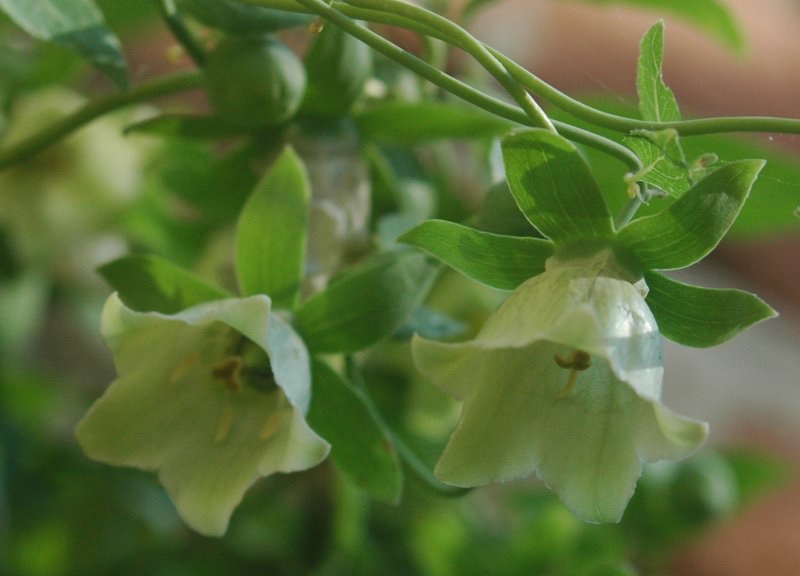
The vine
Codonopsis,
as it actually grows.
Codonopsis pilosula — dang shen, the bellflower vine whose sweet root is the gentle, everyday stand-in for ginseng in Chinese kitchen-medicine.
Doronenko · CC BY 2.5 · Wikimedia Commons
How to Use
Across the Three Kingdoms
One herb, prepared once, serving people, pets, and plants from a single botanical practice — each with its own measure and care.
People
Benefit
natural energy, stamina, and endurance — plus digestive comfort
How to Use
1/4 tsp (up to 1 tsp) in hot water, tea, coffee, a smoothie, or food, once daily — begin with light doses; our extracts are very potent.
Pets
Dogs & companion animals
Benefit
A gentle Qi-tonic root that supports energy, stamina, digestive comfort, and a healthy stress response.
How to Use
Add a small amount of the dilute extract/powder to food, scaled to body weight; start low and build up gradually. A pinch for cats and small birds, up to a small spoonful for large dogs and horses.
By Animal
Cats
Non-toxic per ASPCA; no aromatic oils/phenols, so no glucuronidation concern. Used in veterinary TCM tonics.
Dogs
Non-toxic; common ingredient in canine TCM Qi/immune formulas. Oral decoctions tolerated in dogs at 10-40g.
Horses
Food-grade Qi tonic, not an iodine/glycyrrhizin/aromatic source; well tolerated in moderate dilute use.
Birds
Non-aromatic water-soluble tonic root; no essential-oil volatiles that endanger birds. Tiny dose, start low.
⚑ Sport horses: Not named on the FEI Equine Prohibited Substances List or USEF banned list, but as an adaptogenic tonic affecting stamina/demeanor it falls under USEF's general caution against tonics/pastes/powders of unknown composition; withdraw before competition and confirm with FEI/USEF before use in a tested horse.
Safety
Codonopsis pilosula (dang shen) is a food-grade Qi tonic and is not listed as toxic to cats, dogs, or horses in the ASPCA toxic/non-toxic plant database; it contains no aromatic essential oils or eugenol/phenols, so it carries none of the cat/bird aromatic-oil risk. As a dilute tonic in moderate use it is well tolerated, but observe these CONDITIONAL caveats: (1) Start low and go slow — saponins and high doses can cause transient GI upset (nausea, soft stool, vomiting); reduce or stop if seen. (2) Codonopsis is traditionally used to modestly support blood pressure/circulation and may have mild antiplatelet/blood-sugar effects — use caution and veterinary guidance in animals on anticoagulants/antiplatelet drugs, hypotensives, or insulin/glucose-lowering medication, and discontinue 1-2 weeks before elective surgery. For pregnant, nursing, or medicated animals, use only under veterinary direction. (4) Because it is an immune/Qi tonic, use veterinary guidance in animals with active autoimmune disease or on immunosuppressants. (5) Xylitol is toxic to dogs and alcohol carriers are not appropriate for animals — neither belongs anywhere near an animal's bowl.
Source: ASPCA Toxic and Non-Toxic Plants database (Codonopsis not listed as toxic to dogs/cats/horses) — aspca.org/pet-care/animal-poison-control/toxic-and-non-toxic-plants; Herbal Reality Codonopsis monograph; PMC11128667 systematic review of Codonopsis pilosula; canine oral decoction study (PubMed 11601317); FEI Equine Prohibited Substances List (inside.fei.org); 2026 USEF Guidelines & Rules for Drugs and Medications (usef.org)
Plants
Garden, soil & foliage
Benefit
vegetative vigor, strong rooting, and resilient new growth
How to Use
Dilute 1/8 to 1/4 teaspoon per gallon of water. Foliar feed at the lighter rate, or soil drench at the fuller rate, about once a month or every other feeding. Best worked in through vegetative growth, as the plant builds leaf, stem, and root.
Best for
Vegetative growthSafety
A dilute extract in the GGG Plants line; always dilute and start light.
Source: GGG Plants line formulation
Structure-and-function guidance for nutrition and vitality. Not intended to diagnose, treat, cure, or prevent any disease. Introduce one botanical at a time and notice how the body responds. Some plants interact with medication; if you are pregnant, nursing, or on a prescription, know the interaction before you begin.
What's inside
Codonopsis,
down to the molecule.
The signature compound of Codonopsis, rendered from its real structure in bronze and glass — the precise thing the plant carries, given the dignity it has earned.
The evidence chain
From the plant to the molecule to the body — traced.
Not a claim — a chain. Every link below traces to a primary record. This is what Codonopsis is, measured.
The plant
Codonopsis
which governs
An enzyme that converts fatty acids into messengers of the inflammatory response.
serving the system
Digestive · Kidney
and the tradition independently agrees — measured binding
The recorded herbal lineage names Codonopsis a metabolic and respiratory herb. Independently, its compounds are measured to bind proteins of those systems. Tradition and molecule, arrived at separately, converge — the strongest evidence we hold.
Structure and function only. The chain describes the plant’s characterized chemistry and traditional use — not a claim to treat, cure, or prevent any disease.
How it works
How Codonopsis works in the body
A herb is never one thing — it is a community of compounds, each meeting the body in its own way. These are the active molecules in Codonopsis and the proteins each one is measured to engage: the precise points where the plant meets your biology. So you see not just that it works, but how.

Syringin
PubChem ↗Measured to act on
An enzyme that makes prostaglandins for everyday housekeeping like stomach lining and blood flow.
Concentrated in urinary bladder, skin 1, intestinestructure resolved ↗
An enzyme that breaks down fatty-acid signals involved in blood vessel and inflammation balance.
Concentrated in liverstructure resolved ↗
Atractylenolide I
PubChem ↗Measured to act on
An enzyme that converts fatty acids into messengers of the inflammatory response.
Concentrated in lymphoid tissue, lungstructure resolved ↗
An enzyme that makes prostaglandins for everyday housekeeping like stomach lining and blood flow.
Concentrated in urinary bladder, skin 1, intestinestructure resolved ↗
A guardian protein that watches over DNA and helps cells decide when to repair or stop dividing.
Atractylenolide II
Measured to act on
A sensor that detects bile acids and governs fat, cholesterol, and digestive balance.
Concentrated in liver, intestinestructure resolved ↗
A receptor that responds to progesterone, a hormone central to reproductive cycles.
Concentrated in endometrium 1, smooth muscle, cervix, fallopian tubestructure resolved ↗
An enzyme that converts fatty acids into messengers of the inflammatory response.
Concentrated in lymphoid tissue, lungstructure resolved ↗
An enzyme that makes prostaglandins for everyday housekeeping like stomach lining and blood flow.
Concentrated in urinary bladder, skin 1, intestinestructure resolved ↗
Atractylenolide III
PubChem ↗Measured to act on
A sensor that detects bile acids and governs fat, cholesterol, and digestive balance.
Concentrated in liver, intestinestructure resolved ↗
A receptor that responds to progesterone, a hormone central to reproductive cycles.
Concentrated in endometrium 1, smooth muscle, cervix, fallopian tubestructure resolved ↗
An enzyme that helps the body store cholesterol within cells.
Concentrated in adrenal glandstructure resolved ↗
An intestinal and liver enzyme involved in handling and storing cholesterol.
Concentrated in intestinestructure resolved ↗
An enzyme that converts fatty acids into messengers of the inflammatory response.
Concentrated in lymphoid tissue, lungstructure resolved ↗
An enzyme that makes prostaglandins for everyday housekeeping like stomach lining and blood flow.
Concentrated in urinary bladder, skin 1, intestinestructure resolved ↗
Stigmasterol
PubChem ↗Measured to act on
A serotonin receptor involved in mood, body clock rhythms, and blood vessel tone.
Concentrated in parathyroid gland, testisstructure resolved ↗
Spinasterol (alpha-spinasterol)
PubChem ↗Measured to act on
An enzyme that converts glucose into a related sugar alcohol as part of cellular metabolism.
Concentrated in adrenal glandstructure resolved ↗
Cited science · not claims
Everything we publish about these plants traces to a primary source — the compounds to PubChem, ChEMBL, and BindingDB, the traditional uses to named, dated herbals. We describe what a plant is and what it is understood to nourish — the body’s own systems, structure and function only. We do not claim it treats, cures, or prevents any disease, and nothing here is a substitute for professional care. See our method & sources →
These statements have not been evaluated by the Food and Drug Administration. Not intended to diagnose, treat, cure, or prevent any disease.
Works alongside
Other herbs that share Codonopsis's terrain
Different plants reaching the same systems of the body — the convergence our genome engine maps. These nourish the terrain Codonopsis supports:
Skin