Measured Biology
The Measured Biology of Moringa
Moringa oleifera
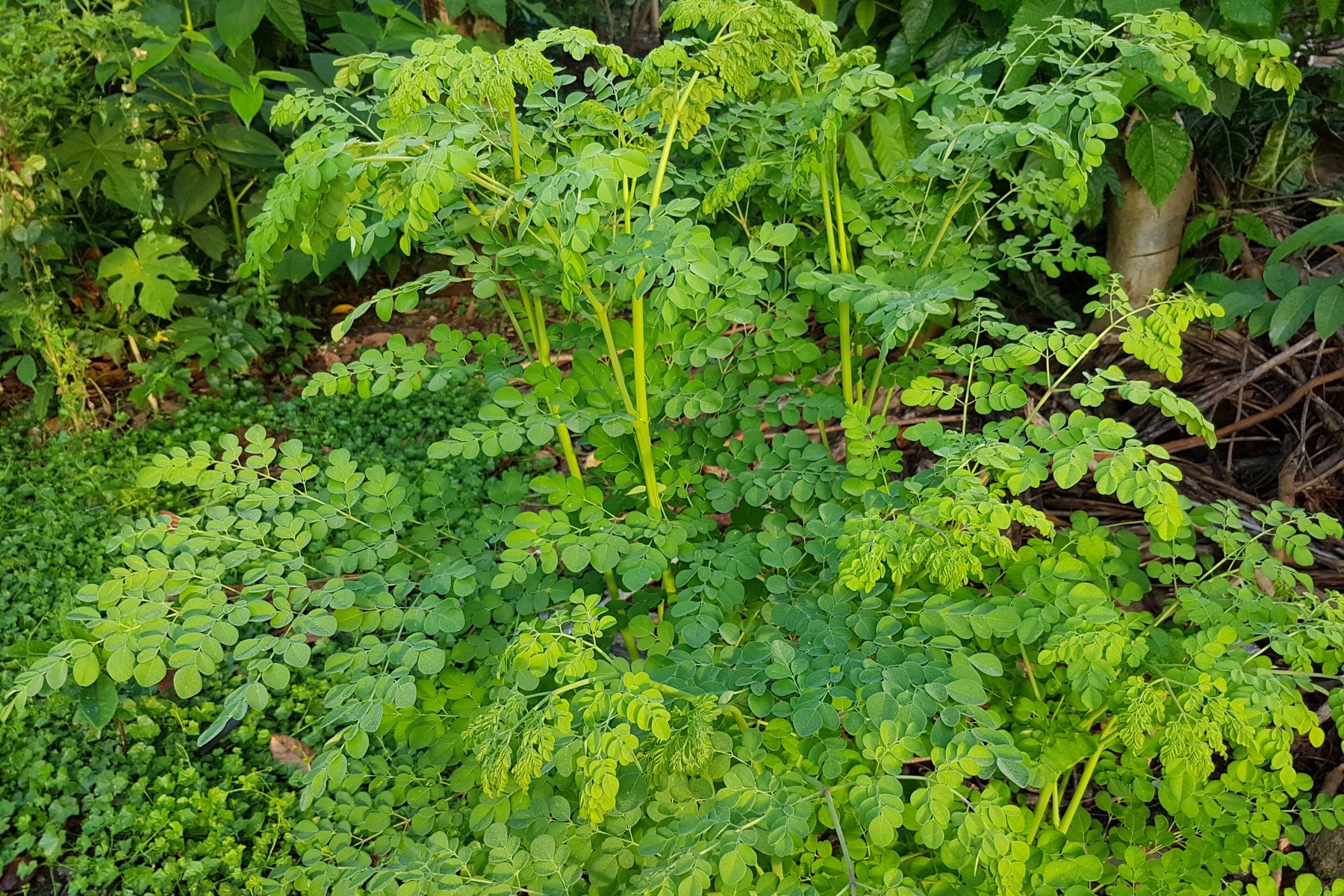
Moringa oleifera is the drumstick tree of the Indian subcontinent and the African dry tropics — a fast-growing, drought-defiant tree that thrives in soils where little else will, and for that reason has been carried across the warm latitudes of the world as a living larder. GGG NATURAL works only with the leaf, the part with the longest and safest record of human use, prepared as a clean raw powder and dilute hot-water extract. The leaf is one of the most nutritionally complete plant foods on earth: it carries a full complement of essential amino acids alongside a dense matrix of vitamins, minerals, and plant pigments, which is why it has been called a foundational green rather than a specialty botanical. In the apothecary it sits in the green kingdom, in the company of the nutrient-dense daily tonics — a herb of vitality, stamina, and endurance, taken not for a moment of need but as steady nourishment woven into the rhythm of the day. Its character is earthy and grounding, generous rather than sharp. Where many revered herbs are concentrated and pointed — taken in small, deliberate measures — moringa is the opposite: an abundant, food-like green meant to be eaten in quantity, a tree that feeds. This is the discipline GGG NATURAL holds around it: the leaf is the food and the tonic; the root, bark, and flower are a different plant entirely in their chemistry and are never used. That line — leaf for nourishment, nothing else — is the whole of how we carry it.
In the body
Moringa leaf is, before anything else, a nutritive green — it engages the body the way food does, supplying the raw building blocks the body's own systems draw upon. It is dense in essential amino acids, the complete set the body cannot make for itself and from which it assembles its structures, enzymes, and messengers; in mineral cofactors such as iron, calcium, magnesium, and potassium on which the body's tissues and signaling depend; and in vitamins across the fat- and water-soluble spectrum. This is why it is framed as a foundation for daily energy, stamina, and endurance: it nourishes the metabolic machinery the body uses to generate its own vitality, rather than pushing it from outside. As a green tonic it supports the body's energy and metabolic systems with sustained, food-grade nutrition. At the level of compound classes, the moringa leaf is well characterized. It carries polyphenols and flavonoids — notably quercetin and kaempferol glycosides — and a family of chlorogenic acids, the same broad antioxidant classes that help the body maintain its own oxidative balance and support the resilience of its cells against everyday oxidative load. Its deep green pigments — chlorophyll and the carotenoids beta-carotene and lutein — are pigment antioxidants that the body recognizes and uses. Moringa is also distinguished by its glucosinolate-derived isothiocyanates, the sulfur-bearing compounds characteristic of its plant family, which engage the body's own antioxidant-response and detoxification systems — the intrinsic cellular pathways that maintain internal balance. Together these classes position moringa as a herb that tones and nourishes the body's nutritional foundation, supports its natural antioxidant balance, and sustains the energy and endurance that arise when those systems are well fed. Structure and function only: moringa is food for the body's own intelligence.
The molecules, measured
The active compounds in Moringa, the proteins each is measured to engage, and — where a real, exact-match assay exists — the strength of that binding.
Quercetin
PubChem ↗Measured to act on
Aromatase
The enzyme that converts androgens into estrogen, the body main estrogen source.
Aldo-keto reductase family 1 member B1
An enzyme that converts glucose into sorbitol, part of how cells handle sugar.
Cytochrome P450 1B1
A liver-type enzyme that processes hormones and environmental compounds.
Serine/threonine-protein kinase PIM-1
A signaling enzyme involved in cell growth and survival.
Cyclin-dependent kinase 1
A master enzyme that drives cells through division into two.
Arachidonate 12-lipoxygenase
An enzyme that converts fatty acids into signaling molecules, some tied to inflammation.
Kaempferol
PubChem ↗Measured to act on
Cytochrome P450 2C9
A liver enzyme that breaks down many compounds the body takes in.
Carbonic anhydrase 7
An enzyme that balances carbon dioxide and acidity, part of the body's pH chemistry.
Aryl hydrocarbon receptor
A sensor protein that detects environmental compounds and adjusts the body's response.
Cytochrome P450 1B1
A liver-type enzyme that processes hormones and environmental compounds.
Dipeptidyl peptidase 4
An enzyme that trims small signaling peptides involved in blood sugar regulation.
Tyrosinase
The key enzyme that makes melanin, the pigment that colors skin and hair.
Apigenin
PubChem ↗Measured to act on
Acetylcholinesterase
The enzyme that clears acetylcholine after a nerve signal fires, resetting communication between nerves.
Cytochrome P450 1B1
A liver-type enzyme that processes hormones and environmental compounds.
Estrogen receptor beta
A second estrogen receptor that fine-tunes hormone signaling across many tissues.
Dipeptidyl peptidase 4
An enzyme that trims small signaling peptides involved in blood sugar regulation.
Transthyretin
A carrier protein that transports thyroid hormone and vitamin A through the blood.
Xanthine dehydrogenase/oxidase
The enzyme that produces uric acid as the body breaks down purines.
Amine oxidase [flavin-containing] A
An enzyme that breaks down messenger chemicals like serotonin in the nervous system.
Chlorogenic acid
PubChem ↗Measured to act on
Tyrosine-protein phosphatase non-receptor type 1
An enzyme that helps regulate insulin and leptin signaling inside cells.
Histone deacetylase
An enzyme that tightens DNA's packaging to help quiet genes.
Aldo-keto reductase family 1 member B1
An enzyme that converts glucose into sorbitol, part of how cells handle sugar.
Caffeic acid
PubChem ↗Measured to act on
Matrix metalloproteinase-9
An enzyme that remodels the scaffolding between cells, part of tissue repair and renewal.
72 kDa type IV collagenase
An enzyme that breaks down collagen, remodeling the scaffolding that holds tissues together.
Type-1 angiotensin II receptor
A receptor that responds to signals governing blood pressure and fluid balance.
NF-kappa-B p105 subunit
Part of a master switch that turns on the body's immune and inflammatory genes.
Interstitial collagenase
An enzyme that breaks down collagen, part of how tissue remodels and renews.
Rutin
PubChem ↗Measured to act on
Beta-secretase 1
An enzyme that cuts proteins at the cell surface, part of normal protein turnover.
Acetylcholinesterase
The enzyme that clears acetylcholine after a nerve signal fires, resetting communication between nerves.
High mobility group protein B1
A protein that helps organize DNA and acts as an alarm signal during tissue stress.
Gallic acid
PubChem ↗Measured to act on
3-hydroxyacyl-CoA dehydrogenase type-2
A mitochondrial enzyme involved in breaking down fatty acids and balancing steroid hormones.
Lysine-specific demethylase 4E
An enzyme that edits chemical tags on DNA-packaging proteins to regulate genes.
Tyrosyl-DNA phosphodiesterase 1
A repair enzyme that clears certain damage points so DNA can be mended.
Beta-sitosterol
PubChem ↗Measured to act on
Prothrombin
A blood protein that, once activated, helps form clots to stop bleeding.
Vanillin
PubChem ↗Measured to act on
Transcription intermediary factor 1-alpha
A protein that helps regulate which genes are read and expressed.
E3 ubiquitin-protein ligase TRIM33
An enzyme that tags other proteins for recycling and helps regulate gene activity.
The classical record
What tradition carried
Moringa's lineage is rooted in the classical traditions of India and the broader warm-climate world. In the Ayurvedic record it is one of the long-recognized food-medicine trees, valued as a nourishing green and used in households as both vegetable and tonic; in the dry tropics of Africa and Asia it earned the folk names "the tree that never dies" and "mother's best friend" for its role as a reliable, cultivated source of leaf nutrition through lean seasons. It is known in East Asian as 辣木 (là mù). Across all of these traditions the recorded use centers on the leaf — eaten fresh, dried, and powdered as everyday food and as a building tonic for strength and stamina — while the more potent root and bark were kept categorically separate and reserved for other, narrower folk purposes. GGG NATURAL carries forward only the leaf tradition: the abundant, food-grade green that generations across India and Africa have relied on as foundational daily nourishment.