Measured Biology
The Measured Biology of Chaga
Inonotus obliquus
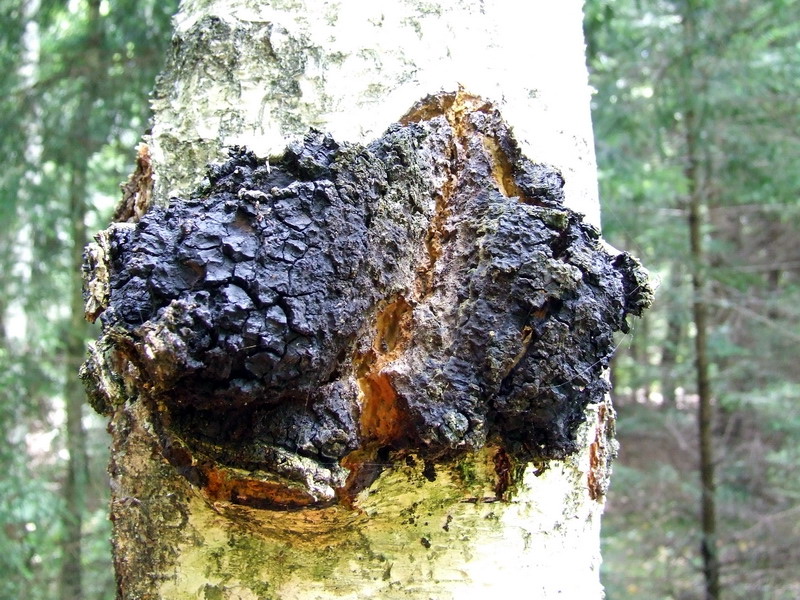
Chaga (Inonotus obliquus) is not a soft, gilled mushroom but a sterile conk — a dense, charcoal-black sclerotium that grows slowly over years on the wounded heartwood of living birch in the cold forests of the far north. Across Siberia and Northern Canada it draws its character from that union: a hard, brittle mass cracked open to reveal a rust-gold interior, carrying the resins of the birch it fed upon. Tradition named it 白桦茸, the "white-birch fungus," and the herbal world has long regarded it as one of the most concentrated botanicals on earth — its blackness the visible signature of an extraordinary melanin and antioxidant density unmatched by almost any other plant or fungus. At GGG NATURAL we present Chaga as a 10:1 hot-water extract of the conk, earthy and grounding on the palate, in the lineage of the great tonic fungi. It is a vitality botanical in the truest sense: not a stimulant, not a quick lift, but a slow, deep, daily tonic whose strength mirrors the patience of its own growth. Where the birch endures the northern winter, Chaga is the embodiment of that endurance — a resilient organism that GGG offers as nourishment for the body's own resilience.
In the body
Chaga's primary affinity is with the immune system — the body's natural intelligence for recognition, defense, and balance. It is exceptionally rich in established compound classes: beta-glucans and other polysaccharides, the fungal triterpenes characteristic of the tonic mushrooms (including betulinic acid drawn from its birch host), a dense fraction of melanin, and a broad spectrum of polyphenols. Beta-glucans and polysaccharides are the structural language the immune system reads — branched sugars the body recognizes and uses to support the immune system's own healthy, well-regulated function, and to tone the body's normal inflammatory balance rather than override it. This is the structure/function heart of Chaga: it engages the body's defenses by feeding the systems already in place, not by acting against any condition. Its second signature is antioxidant capacity. Melanin, polyphenols, and triterpenes form one of the most concentrated antioxidant profiles of any botanical — compound classes that support the body's own cellular defenses against everyday oxidative stress and nourish the resilience of healthy tissue. Through this antioxidant and immune-toning character, Chaga supports steady, daily vitality and the body's grounded sense of strength: the systems of defense and renewal, well-nourished, expressing their own natural balance. A note of precision in keeping with its chemistry — Chaga is naturally high in oxalates, which is why GGG offers it as a dilute, measured tonic, and why those who are mindful of their oxalate intake or who support sensitive kidney and mineral-processing pathways may prefer to keep portions small.
The molecules, measured
The active compounds in Chaga, the proteins each is measured to engage, and — where a real, exact-match assay exists — the strength of that binding.
Betulinic acid
PubChem ↗Measured to act on
Nuclear receptor ROR-gamma
A receptor inside cells that helps direct immune cell development and daily body rhythms.
5'-nucleotidase
An enzyme that recycles the building blocks of DNA and cellular energy molecules.
DNA polymerase beta
An enzyme that helps repair and copy DNA to keep the genetic code intact.
Protocatechuic acid
PubChem ↗Measured to act on
Carbonic anhydrase 2
An enzyme that balances carbon dioxide and acidity throughout the body's fluids.
Carbonic anhydrase 1
An enzyme that helps manage carbon dioxide and acid-base balance in the blood.
3-dehydroquinate synthase
A bacterial enzyme in a pathway plants and microbes use that humans lack entirely.
Gallic acid
PubChem ↗Measured to act on
Polypeptide N-acetylgalactosaminyltransferase 2
An enzyme that attaches sugar groups to proteins, shaping how they fold and function.
P-selectin
An adhesion protein that helps immune cells stick to blood vessel walls.
L-selectin
An adhesion protein that guides white blood cells to where they are needed.
Mushroom tyrosinase
A mushroom enzyme widely used in the lab to study how pigment forms.
Syringic acid
PubChem ↗Measured to act on
Pyruvate kinase PKM
A key enzyme in how cells extract energy from sugar.
Carbonic anhydrase 9
An enzyme that helps cells manage acidity, especially in low-oxygen tissue.
The classical record
What tradition carried
Chaga's recorded use belongs to the cold northern reaches of the herbal world. In the folk traditions of Siberia, the Baltic, and the boreal peoples of Northern Europe and Russia, the birch conk was harvested through the long winters, broken down and steeped as a dark, earthy daily tea — valued for generations as a grounding tonic of strength and endurance for those living in the harshest climates. It carries a parallel lineage in classical East Asian practice, where the tonic fungi as a class — Reishi, Poria, and the birch mushroom among them — were honored as among the highest order of restorative botanicals, taken steadily over time to nourish vitality and constitutional resilience rather than for any acute purpose. It is this tradition of patient, daily tonic use across the northern and Eastern herbal lineages that GGG NATURAL carries forward.