Measured Biology
The Measured Biology of Licorice
Glycyrrhiza glabra
Licorice (Glycyrrhiza glabra) is the great harmonizer of the herbal world — a sweet, golden root whose Latin name, from the Greek glykys (sweet) and rhiza (root), declares its nature plainly: the sweet root. Native to the open soils of southern Europe and western Asia, it has been gathered, peeled, and decocted for so long that nearly every major tradition reserves a place for it. In the East Asian pharmacopoeia it is 甘草, gān cǎo, the "sweet herb," and it carries a singular distinction: across countless classical formulas it appears not as the lead botanical but as the conductor — the root added to unify disparate herbs, soften the harsh, and carry the whole formula into balance. This is its character. Licorice is not a soloist; it is the one that makes an ensemble sing. Cultivated and wild-harvested as a deep, persistent taproot, licorice belongs to the legume family and concentrates its sweetness and its substance below ground, where the plant stores the resources of seasons. GGG NATURAL carries it as a potent 10:1 extract of the root — the form in which its harmonizing, grounding nature is most fully expressed. Within our formulary it sits at the heart of the vitality kingdom: a root prized less for any single dramatic gesture than for the way it tones, sweetens, and brings the whole into accord. It is, fittingly, one of the most universally esteemed botanicals on earth — the synergist that herbalists across millennia reached for to complete a blend.
In the body
Licorice engages two of the body's deep, quiet systems: the digestive tract and the adrenal-renal axis that governs stamina and the body's own response to daily demand. As a demulcent root, it is rich in mucilaginous polysaccharides that bring a soothing, coating quality to the gut lining — supporting the digestive tract's own comfort and the natural integrity of its mucosal surfaces. This is the demulcent's gift: not to act upon the tissue, but to provide the slick, nourishing substance the body recognizes and uses to keep its own surfaces supple and at ease. Its most distinctive constituent is glycyrrhizin, a triterpenoid saponin of remarkable intensity of sweetness, which carries the metabolite glycyrrhetinic acid. This triterpene class is what links licorice to the body's adrenal and cortisol-handling system — the axis that modulates how the body stewards its own steroid hormones, its sodium-potassium balance, and its capacity to meet demand with sustained energy. By engaging this axis, licorice has earned its place among the adaptogenic and adrenal-supporting roots: it nourishes the body's natural resilience system, supporting steady, daily vitality and endurance rather than a spike. Alongside the triterpene saponins, the root carries a broad family of flavonoids — antioxidant compounds that support the body's own balanced, healthy inflammatory response across the digestive and adrenal tissues it touches. Because this same glycyrrhizin engages the body's mineral-balancing pathways so directly, licorice is honored as a potent, grounding tonic taken in measured amounts — the molecular reason our extract is offered in small, deliberate doses.
The molecules, measured
The active compounds in Licorice, the proteins each is measured to engage, and — where a real, exact-match assay exists — the strength of that binding.
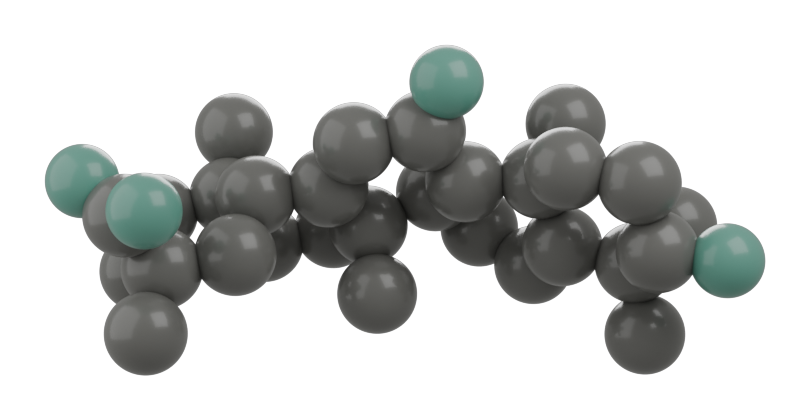
18beta-Glycyrrhetinic acid (enoxolone)
PubChem ↗Measured to act on
11-beta-hydroxysteroid dehydrogenase type 1
An enzyme in tissues like fat and liver that activates the stress hormone cortisol.
11-beta-hydroxysteroid dehydrogenase type 2
A kidney enzyme that switches off cortisol, helping the body manage salt and fluid balance.
Protein kinase C eta type
A signaling enzyme involved in skin cell growth and how cells respond to their environment.
Prelamin-A/C
A structural protein that forms the scaffold giving each cell nucleus its shape and stability.
Liquiritigenin
PubChem ↗Measured to act on
Estrogen receptor beta
A receptor that reads the hormone estrogen, helping govern reproductive and other tissues.
Tubulin
The building-block protein of the internal scaffolding that gives cells shape and moves their parts.
Glabridin
PubChem ↗Measured to act on
Tyrosinase
The copper enzyme that makes melanin, the pigment that colors skin and hair.
Mushroom tyrosinase
A mushroom enzyme used in the lab as a stand-in to study how skin pigment forms.
The classical record
What tradition carried
Few roots are so universally recorded. Nicholas Culpeper, in his 1653 English Physician, set licorice under the gentle dominion of Mercury and praised it as a sweet, opening root for the chest and the passages of the body — the herbalist's standby for soothing demulcent work. The Old English Herbals and the later Thomsonian system carried it forward as a softening, harmonizing agent folded into countless preparations. Yet its highest station belongs to classical East Asian herbalism, where gān cǎo (甘草) is described as entering all twelve channels and is among the most frequently used herbs in the entire materia medica — the great harmonizer added to moderate, unify, and sweeten a formula, reconciling herbs that would otherwise pull against one another. From the apothecaries of Europe to the formula traditions of Asia, licorice is the root every lineage reached for to make a blend whole.