Measured Biology
The Measured Biology of Purple Mulberry
Morus nigra
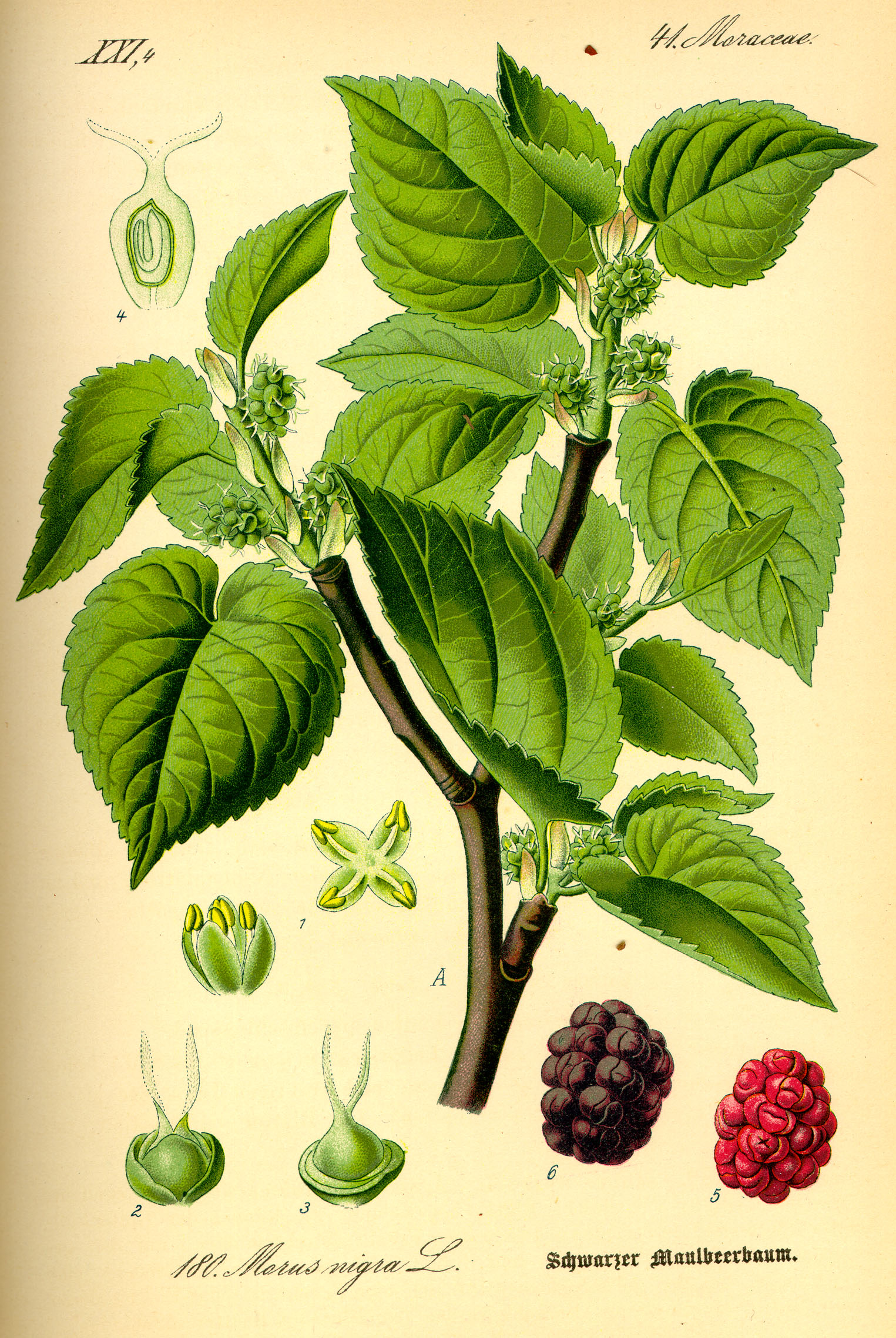
Purple Mulberry (Morus nigra) is the deep-jeweled fruit of the black mulberry — a slow-growing, long-lived tree whose berries ripen from crimson to an ink-dark purple so saturated it stains the hand. Native to the warm belt running from the Middle East across Asia, it is the most heavily pigmented of the mulberries, and that pigment is the whole point: each berry is dense with the anthocyanin and stilbene-class polyphenols that give it both its color and its character. Where its paler cousin Morus alba (桑葚, sang shen) is prized as a gentle, moistening blood-and-fluid restorative, Morus nigra is the bolder sibling — sweeter, darker, more concentrated, a fruit of vitality rather than mere refreshment. GGG renders it as a potent 10:1 ripe-fruit extract, the berry alone, never the leaf, bark, or twig.
In the body
Purple Mulberry engages the body chiefly through the blood and circulatory system, and through the deep reserve of daily vitality that the herbal tradition reads in the blood. Its signature is its polyphenol load: anthocyanins (the purple pigment class) and resveratrol-family stilbenes are well-established antioxidant compounds, and they support the body's own capacity to maintain healthy oxidative balance — nourishing the antioxidant status the tissues rely on to stay resilient, supple, and radiant. As a richly pigmented berry tonic it tones the blood and supports the circulatory system's natural function, the foundation the tradition links to steady energy, stamina, and hair vitality. The mulberry also carries a characteristic iminosugar alkaloid worth naming for what it is — DNJ (1-deoxynojirimycin), one of the plant's own signature molecules — which the tradition associates with nourishing the body's metabolic system and its natural sense of balance after a meal. Together these compound classes work not by overriding the body but by feeding its own regulatory intelligence — antioxidant defenses, circulatory tone, and metabolic balance — toward grounded, sustained strength.
The molecules, measured
The active compounds in Purple Mulberry, the proteins each is measured to engage, and — where a real, exact-match assay exists — the strength of that binding.
Quercetin
PubChem ↗Measured to act on
Aldo-keto reductase family 1 member B1
An enzyme that converts excess glucose into sorbitol as part of sugar metabolism.
Polyunsaturated fatty acid 5-lipoxygenase
An enzyme that converts fatty acids into messengers of the inflammatory response.
Neuraminidase
An enzyme the influenza virus uses to release newly made copies from a host cell.
Rutin (quercetin-3-O-rutinoside)
PubChem ↗Measured to act on
Neuraminidase
An enzyme the influenza virus uses to release newly made copies from a host cell.
Xanthine dehydrogenase/oxidase
The enzyme that produces uric acid as the body breaks down spent genetic building blocks.
Chlorogenic acid
PubChem ↗Measured to act on
Human immunodeficiency virus type 1 integrase
A viral enzyme that splices viral genetic material into a host cell's DNA.
Tyrosine-protein phosphatase non-receptor type 1
An enzyme that helps regulate insulin and leptin signaling inside cells.
Resveratrol
PubChem ↗Measured to act on
Microtubule-associated protein tau
A structural protein that stabilizes the internal scaffolding of nerve cells.
Nuclear receptor ROR-gamma
A receptor that helps direct the maturation of certain immune cells.
Prostaglandin G/H synthase 2
The enzyme that drives the body's inflammatory response.
1-Deoxynojirimycin (DNJ / duvoglustat)
PubChem ↗Measured to act on
Sucrase-isomaltase, intestinal
A gut enzyme that breaks dietary starch and table sugar into absorbable simple sugars.
Lysosomal alpha-glucosidase
An enzyme inside cells that breaks down stored glycogen into usable glucose.
Maltase-glucoamylase
A gut enzyme that finishes digesting starch into glucose for absorption.
Cyanidin (aglycone of cyanidin-3-glucoside, the major Morus nigra fruit anthocyanin)
PubChem ↗Measured to act on
Oxysterols receptor LXR-alpha
A receptor that senses cholesterol and helps govern fat and cholesterol balance.
Prothrombin
A blood protein that, once activated, helps form clots and stop bleeding.
The classical record
What tradition carried
Mulberry has a long and unbroken place across the herbal traditions GGG carries. In classical East Asian practice the mulberry fruit (桑葚, sang shen) is a celebrated blood-and-fluid nourisher, valued for replenishing the body's reserves and supporting vitality, dark hair, and the moisture of the tissues. In the Western lineage the berry appears throughout the Old English herbals and in Culpeper, who recorded the mulberry as a cooling, binding, restorative fruit. Carried along the trade roads from Persia and the Levant into the gardens of Asia and the Mediterranean, the black mulberry was cultivated for centuries as both a prized table fruit and a tonic — a fruit eaten as much for strength as for pleasure, and that is the tradition GGG continues.