mineral
Zeolite
Suitable For
A natural volcanic mineral with a crystalline honeycomb lattice that functions as a molecular sieve. Its negatively charged structure binds and carries out positively charged compounds — a precise, gentle binder.
What it nourishes in the body
The body systems this herb is traditionally understood to support — resolved through our knowledge graph, where the classical record and modern biology are read together. Structure and function, never a claim of treatment.
Whole Herb
Whole-plant. Small-batch. Potent.
How to take it
1/4 to 1/2 tsp stirred into a full glass of water, away from meals and medications, then follow with more water. Not taken with food or other supplements.
Whole plant, never isolated
Concentrated extracts of the whole botanical — the way the body recognizes it.
Cited to measured biology
Every action we describe traces to the compound and its measured target.
Structure & function
We describe what an herb nourishes — never a claim to treat disease.
Secure checkout
Encrypted payment and human verification on every order.
The Mineral
Zeolite, in depth
Character
Zeolite is not an herb but a mineral — a crystalline aluminosilicate born of the meeting of volcanic ash and water, where molten glass cooled and recrystallized over geologic time into one of nature's most precise architectures. The variety we carry, clinoptilolite, is the most studied of the natural zeolites: a honeycomb lattice of silicon, aluminum, and oxygen riddled with uniform microscopic channels and cages, every cavity carrying a faint negative surface charge. This is what makes it a molecular sieve — a structure that sorts the world by size and charge, drawing positively charged particles into its framework and holding them by simple physical attraction. It is inert in the truest sense: not absorbed, not metabolized, not transformed by the body. It enters as mineral and leaves as mineral, doing its work entirely by the geometry of its surface. In the apothecary it sits among the binders and grounding minerals — bentonite clay its cousin in purpose — a quiet, elemental tool of clearing rather than a botanical of warmth or flavor. Where the herbs carry the intelligence of living plants, zeolite carries the intelligence of stone: order, structure, and the patient work of holding and carrying away.
Its character is gentleness expressed through precision. It does not stimulate, heat, or move the body the way an herb does; it offers the body a clean, charged surface and lets the body's own passage do the rest. This is its place in the lineage — the mineral kingdom's contribution to a tradition that has always reached for clay, ash, and stone alongside leaf and root.
In the Body
Zeolite engages the body's terrain of clearing and grounding — the digestive tract and the body's own pathways of elimination, which it supports without ever entering the bloodstream. Because clinoptilolite is not absorbed, its entire engagement happens at the surface of its lattice as it passes through the gut. The established mechanism is adsorption and cation exchange: the framework's negative charge and uniform pore structure bind positively charged particles to its surface, and the body carries them out along its natural route. This is structure-and-function in its most literal form — a physical scaffold offered to the body's own clearing systems, supporting the gut's natural housekeeping and the body's innate sense of internal balance. It supports healthy stool form by drawing and holding water within the tract, which is why ample fresh water belongs alongside it.
The compound class here is the aluminosilicate framework itself — not a phytochemical but a mineral architecture. Its tetrahedral silica-alumina cages are the active principle, and their selectivity for charge and size is the whole of how they work. Alongside this binding action, the natural mineral carries a trace mineral signature — small amounts of the silica and minerals native to its volcanic origin — that accompanies its passage. In the GGG Plants line, this same charged lattice supports vigor, rooting, and resilience as a dilute soil drench or foliar feed, layering its minerals into the root zone and lending structure to the soil's own exchange of nutrients. Across people, animals, and plants, zeolite nourishes the same principle: it supports the body's — or the soil's — innate capacity to hold what it needs and let go of what it does not.
The Tradition
Mineral binders belong to one of the oldest threads in the human herbal record. Long before the chemistry of clays and zeolites was understood, traditional practice across many cultures reached for edible earths, volcanic ash, and clay — the practice of geophagy and clay-eating documented from antiquity through the folk traditions of Europe, Africa, and the Americas — as grounding minerals taken to settle and steady the digestive terrain. Zeolite's volcanic origin places it squarely in this lineage of stone-and-ash remedies, kin to the clays that herbalists and folk practitioners have always kept alongside their roots and leaves. Clinoptilolite of sedimentary and volcanic origin has long been regarded as a safe, inert mineral binder across the animal kingdoms, which is why it carries equal standing in our People, Pets, and Plants lines. We carry it in that long tradition: the mineral kingdom's offering of structure, clearing, and grounding, a tool the body recognizes by its geometry alone.
The mineral
Zeolite,
as it actually grows.
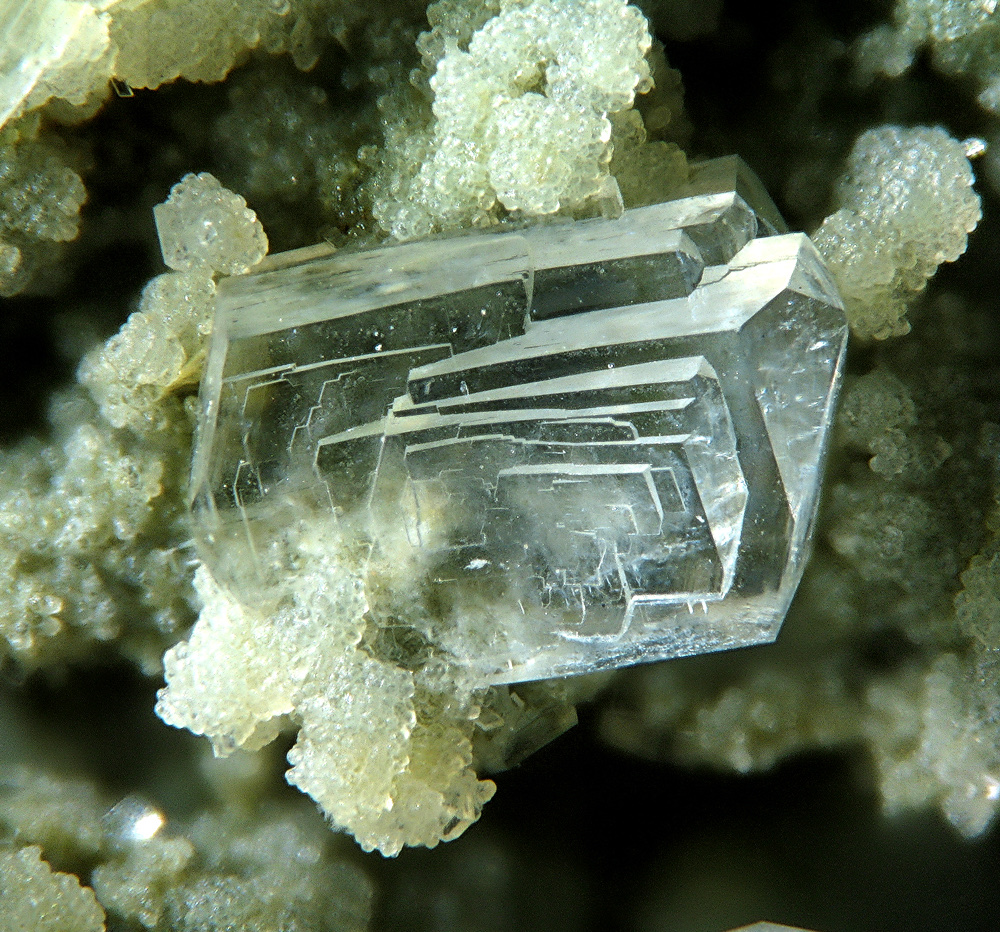
Clinoptilolite — the pale volcanic zeolite whose microscopic cage-like lattice traps and exchanges ions by structure alone. Long valued as a gentle binding mineral in the apothecary.
Christian Rewitzer · CC BY-SA 3.0 · Wikimedia Commons
How to Use
Across the Three Kingdoms
One herb, prepared once, serving people, pets, and plants from a single botanical practice — each with its own measure and care.
People
Benefit
gentle binding and cleansing support, plus trace minerals
How to Use
1/4 to 1/2 tsp stirred into a full glass of water, away from meals and medications, then follow with more water. Not taken with food or other supplements.
Pets
Dogs & companion animals
Benefit
Mineral binder that supports gut tone, normal toxin/heavy-metal clearance, and firmer stool quality.
How to Use
Mix a small amount of the dilute powder/extract into food, scaled to body weight; start at half-dose for 3-5 days and always provide free access to fresh water.
By Animal
Cats
Inert mineral, not absorbed; EFSA-safe for all species. Keep ~2-3h apart from meds, ensure water.
Dogs
Well-tolerated feed-grade binder; very low acute oral toxicity. Provide ample water during use.
Horses
Inert aluminosilicate, no iodine/glycyrrhizin load; used as equine gut buffer/binder. Hindgut-safe at moderate dose.
Birds
Explicitly assessed safe for poultry by EFSA as feed additive; avoid inhaled dust when mixing into food.
⚑ Sport horses: none — clinoptilolite is an inert mineral binder with no pharmacological action and is not on the FEI/USEF Equine Prohibited Substances Lists. Standard caveat: it can bind co-administered medications, so dose it apart from any permitted treatments.
Safety
Clinoptilolite is an inert aluminosilicate that is not absorbed or metabolized — it passes through the gut and acts by surface adsorption, so it has no species-specific metabolic toxicity (the cat glucuronidation/phenol concern does not apply: there are no aromatic or essential-oil actives here). Real cautions are CONDITIONAL, not class downgrades: (1) Because it binds in the gut, separate it from oral medications and trace-mineral supplements by ~2-3 hours to avoid reducing their absorption. (2) It firms stool by drawing water — always ensure free access to fresh water; do not use in a dehydrated animal or alongside other binders/antidiarrheals without veterinary guidance. (3) Start low and go slow; transient constipation or reduced appetite means back off. (4) In pregnancy/lactation, kidney or liver disease, or any animal on a tightly managed drug or mineral regimen, use only under veterinary supervision. (5) Only use food/feed-grade veterinary clinoptilolite — industrial-grade material may contain impurities or fibrous/crystalline forms unsuitable for ingestion; dry powder can be a respiratory irritant, so avoid creating dust when dosing.
Source: EFSA FEEDAP Scientific Opinion on clinoptilolite of sedimentary origin for all animal species (EFSA Journal 2013;11(1):3039) and 2025 renewal (EFSA Journal 2025, ZEOCEM a.s., PMC11986687); EFSA opinion on clinoptilolite of volcanic origin for all terrestrial species (IMERYS, PMC12696417); Kraljević Pavelić et al., "Critical Review on Zeolite Clinoptilolite Safety and Medical Applications in vivo" (Front. Pharmacol. 2018, PMC6277462); FEI 2026 Equine Prohibited Substances List; USEF 2026 Guidelines & Rules for Drugs and Medications.
Plants
Garden, soil & foliage
Benefit
whole-cycle vigor, resilience, and a living root zone
How to Use
Dilute 1/8 to 1/4 teaspoon per gallon of water. Foliar feed at the lighter rate, or soil drench at the fuller rate, about once a month or every other feeding. Used the entire way, through both vegetative growth and bloom.
Best for
Whole cycle — growth & bloomSafety
A dilute extract in the GGG Plants line; always dilute and start light.
Source: GGG Plants line formulation
Structure-and-function guidance for nutrition and vitality. Not intended to diagnose, treat, cure, or prevent any disease. Introduce one botanical at a time and notice how the body responds. Some plants interact with medication; if you are pregnant, nursing, or on a prescription, know the interaction before you begin.
What's inside
Zeolite,
down to the molecule.
The signature compound of Zeolite, rendered from its real structure in bronze and glass — the precise thing the plant carries, given the dignity it has earned.
Works alongside
Other herbs that share Zeolite's terrain
Different plants reaching the same systems of the body — the convergence our genome engine maps. These nourish the terrain Zeolite supports: